

Corrugated Hose
Ningbo Yowin Pipe Industry Co., Ltd. specializes in offering include Corrugated Hoses, flexible connectors for pipeline systems, industrial and household hose assemblies, and related accessories such as hose clamps and adaptors.
You Professional Corrugated Hose Suppliers!
We specialize in producing high-quality stainless steel corrugated hoses for various industrial and residential applications. Our products are engineered to deliver exceptional performance, safety and longevity in demanding environments.




Why Choose Us?
Rich Experience
Ningbo Yowin Pipe Industry Co.,Ltd. is specialized in production of various stainless steel corrugated hoses, braided hoses and stainless steel shower hose for more than 15 years.
Strong Production Capacity
Till now, our production capacity is 3 000 000 pcs for corrugated hose and braided hose every year. We also can produce OEM products according to our customer's samples or drawing.
Reliable Product Quality
Strict quality control covers every procedure, from material sourcing and processing through to testing and packing. We understand that high quality and innovative products, quick lead times, accurate shipping and friendly service is what you want.
Wide Range of Applications
Mainly produce the corrugated hose, braided hose, shower hose etc. Our Products widely use in bathroom and kitchen room for water industry and gas industry. Our high qualified goods receive well reputation from our customer all over the world.
What is Corrugated Hose?
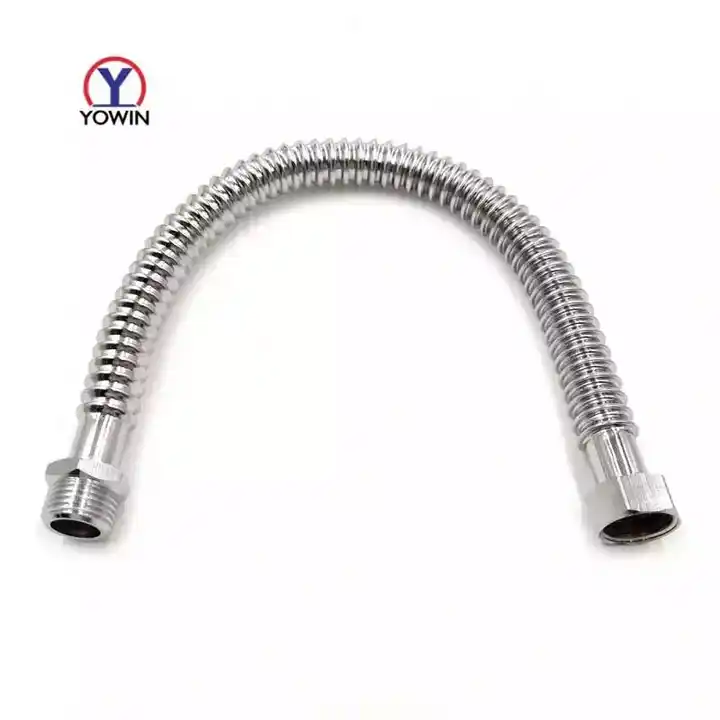
The corrugated hose has a thin-wall metal tube that has helical or annular corrugations. This type of hose is generally covered with metal wires woven in a basket weave fashion. This acts as a reinforcement so that the inner tube can withstand the working pressures.
Advantages of Corrugated Hose
Flexibility
The primary advantage of corrugated hoses is their flexibility. They can bend and twist without breaking, which makes them ideal for applications where rigid piping would not work. This flexibility also allows for easier installation in tight spaces and around obstacles.
Durability
Corrugated hoses are made of high-quality metal alloys, which make them strong, durable, and resistant to wear and tear. They can withstand high pressures, extreme temperatures, and corrosive environments, making them suitable for use in harsh conditions.
Corrosion Resistance
Corrugated hoses are resistant to corrosion, which makes them suitable for use in applications where corrosion is a concern. They are commonly used in chemical processing plants, food and beverage industries, and marine applications.
High Temperature Resistance
Corrugated hoses can withstand high temperatures, making them suitable for use in high-temperature applications. They are commonly used in steam and hot water applications, as well as in high-temperature air and gas applications.
Leak-Free
Corrugated hoses are designed to be leak-free, which makes them ideal for use in applications where leakage is unacceptable. They are commonly used in hydraulic and pneumatic systems, as well as in high-pressure gas and liquid applications.
Types of Corrugated Hose
Corrugated Rubber Hose
A corrugated rubber hose is a hollow tube designed to transfer fluids from one place to another. Also, these hoses are cylindrical. You can use it in water or any other liquid material to transfer air or gaseous material. Also, you can use air or gaseous material to transfer liquid materials.
Corrugated Fuel Hose
One is A2 labeled hose. They have a USCG fire rating. Also, it has a higher flow rate of 300 g / m² / day. This is also permitted in engine rooms, but you should only use it for refueling or venting hoses to your fuel tank. Another one is A1 labeled hose. They are usually designed and marked for use in refueling engines on boats or ships. A1 labeled hoses are used in tanks with solid fuel in your hose. On the other hand, A2 labeled hoses are for filling hoses only.
Corrugated Plastic Hose
Corrugated plastic hoses contain durable materials. They are the most chemically dormant drainage items on the market, making them highly corrosive chemicals and gases resistant. However, they are very durable and don’t rust much. When using gravity drainage, the connections are sealed.
Corrugated Metal Hose
Corrugated metal hoses are flexible hoses that provide non-rigid connections to transport semi-solids, liquids, and gases. It is perfect for absorbing shock, correcting misalignment, contraction of piping or thermal expansion, and protecting gear from excessive movement.
Corrugated Drain Hose
Corrugated drain hoses have come out with grooves and ridges features identical to each on the surface. These hoses are used when versatility is an essential factor in durabilities, like gutters and ditches.
When To Use Metal Corrugated Hose


Temperature Extremes
If either the temperature of the media going through the corrugated corrugated hose or the surrounding atmospheric temperature is very cold or hot, metal may be the only material that can withstand the temperature extremes.
Chemical Compatibility
Metal corrugated corrugated hose can handle a wider variety of chemicals than most of the other corrugated corrugated hose types. If the corrugated corrugated hose will be exposed to aggressive chemicals (either internally or externally), metal corrugated corrugated hose should be considered. Stainless steel exhibits good resistance to many common chemicals and special alloys may be used for added corrosion resistance.
Permeation Concerns
Non-metal corrugated corrugated hose is susceptible to having gases permeate through the corrugated corrugated hose wall and into the atmosphere. Metal corrugated corrugated hose, on the other hand, does not allow permeation when properly fabricated. If containing the gases inside the corrugated corrugated hose is important, metal corrugated corrugated hose may be required.
Potential for Catastrophic Failure
When a metal corrugated corrugated hose fails, it usually develops small holes or cracks. Other corrugated corrugated hose types tend to develop larger cracks or come apart completely. In non-metallic corrugated corrugated hoses, barbed fittings are typically held onto the corrugated corrugated hose ends using clamps or crimped collars. Because fittings are welded to metal corrugated corrugated hose, fitting retention problems are nearly non-existent.
Abrasion and Over bending Concerns
To prevent abrasion and over bending, a metal corrugated corrugated hose can be used as a protective cover over wires or even other corrugated corrugated hoses. Stripwound corrugated corrugated hose can be very abrasion resistant, making it ideal for use as protection to corrugated corrugated corrugated hose from either abrasive media or external damage. Stripwound corrugated corrugated hose can also be applied to the outside of a corrugated corrugated corrugated hose to prevent it from overbending.
Fire Safety
Other corrugated corrugated hose types will melt when exposed to fire while metal corrugated corrugated hose maintains its integrity up to 1200º F. Flexible corrugated corrugated corrugated hoses are usually all-metal (unless a fitting contains a non-metallic seal), which makes them naturally fire-resistant. Low permeation and fire resistance make corrugated corrugated corrugated hoses the preferred choice for barge loading and unloading applications, or any application where the corrugated corrugated hose may be exposed to an open flame.
Achieving Full Vacuum
Under full vacuum, metal corrugated corrugated hose maintains its shape while other corrugated corrugated hose types may collapse. The corrugations in a metal corrugated corrugated hose give it excellent hoop strength, which gives it the ability to handle a full vacuum. Nonmetallic corrugated corrugated hoses must use helix wires to improve their vacuum rating, but collapse is still possible.
Flexibility in Fitting Configuration
Any weld-able fitting can be incorporated into a corrugated corrugated corrugated hose assembly, and in any configuration, while other corrugated corrugated hose types require special shanks and collars. This can be a benefit over other corrugated corrugated hose types that would require multiple threaded connections to connect several corrugated corrugated hoses together. Every threaded connection is a potential leakage point, so every welded fitting eliminates a leakage point and can facilitate installation.
Structure of Corrugated Hose

Corrugated structure
Corrugated hose is characterized by its unique corrugated structure. This structure can effectively disperse the stress under the action of external force and improve the bending resistance. In addition, the corrugated structure also gives the metal hose excellent impact resistance. It has a long service life in complex environments.

Metal layer
The metal layer of corrugated hose is mainly made of stainless steel, carbon steel, etc. It has high strength and corrosion resistance to ensure its stable performance. The special processing technology gives the metal hose excellent ductility and elasticity. Therefore it can meet diverse engineering needs.

Lining layer
The lining layer is mainly used to prevent the medium inside the metal hose from coming into direct contact with the metal layer. Thereby reducing the corrosive effect of the medium. The inner lining material is generally non-metallic materials such as PE and PP. Has good corrosion resistance and friction properties.

Sealed structure
The sealing structure of corrugated hose is divided into nozzle sealing and sealing between bellows. The pipe mouth seal adopts metal flange, threaded connection and other methods to ensure stable connection and sealing performance. The seal between bellows is specially designed to achieve the sealing performance of the metal hose during expansion and contraction.
Correct hose length
Allow enough length for the hose to flex without stretching or compressing excessively. This prevents stress at the end fittings and prolongs the hose life.
Avoid twists during installation
Keep the corrugated hose straight during the installation to prevent torsional stress. Any twist in the hose can reduce its ability to withstand pressure and lead to premature failure. This is particularly important if the hose gets twisted a lot.
Preparing the installation site
Ensure the area is clean and free of any debris that might damage the hose. Check for sharp edges or rough surfaces along the installation path.
Handling and storage
Handle the hose with care to avoid kinking or twisting. Store it away from direct sunlight and extreme temperatures to prevent material degradation.
Securing the corrugated hose
Use proper supports and clamps to secure the corrugated hose, especially in applications involving vibration or movement.
Corrugated Hose vs Braided Hose: Detailed Key Differences
Corrugated stainless steel hose: These hoses are utilized for high-temperature fluid and gas transport, for example, a water heater intake pipe, a faucet inlet pipe, a gas delivery pipe, and so on. In places with low water quality, the connecting connection of the water heater should be a corrugated pipe, which will survive longer.
Braided stainless steel flexible hose: This hose is mostly used to link the angle lever at the water input to the dining faucet, sink faucet, water heater, vertical tub faucet, central air conditioning system, and toilet in order to create a water management route or drainage pipe.
Corrugated hose: To burn, cut a section of PVC pipe. The flame is green on the surface and yellow on the interior, making it easily extinguishable. The burning odor is strong and overpowering.
Braided hose: To burn with a lighter, cut a little piece of HDPE pipe. The flame is blue on the exterior and yellow inside, and the burning scent is similar to that of a candle.
PVC double-wall corrugated pipes’ inlet and outlet layers are often white or beige, where the HDPE double-wall corrugated hose has a black outer layer and a blue interior layer.
Corrugated flexible hose: The SS corrugated flexible hose tube body is uneven, with just one outer tube, no inner tube, and a stiff tube body. Please pay close attention to the installation process. To minimize water leaks and breakage, use vertical installation and not bend in the exact location many times.
Braided flexible hose: The braided flexible hose has six strands of 304 steel wire braided into it. The entire tube is flexible and provides a tremendous explosion-proof effect. However, the diameter is smaller than the bellows; thus, the water flow is little.
Is It Time to Replace Your Corrugated Hose?
Leaks and Reduced Performance
If you notice small puddles under corrugated hoses or on the surface of corrugated hoses, this is often a sign of a leak somewhere in the corrugated hose or fitting. Reduced pressure or flow can also be a sign of a leak somewhere in the system, especially if the system is normally consistent. Small leaks can quickly expand, leading to larger spills and severely reduced flow/performance. In addition to the corrugated hose and fittings, be sure to check all seals to ensure that they are in optimal condition. If your seals are in good condition and fitted properly, your corrugated hose is likely damaged and will need to be replaced.
Loose Connections and Slippage
A full and secure seal at both connection points is crucial for minimizing the risk of spills, leaks, and equipment damage. If this connection starts to loosen and can no longer be tightened, this is a sure sign that it is time for a replacement. Slippage can cause corrugated hoses to come loose and fall off, leading to potential safety risks for surrounding personnel. If you handle hazardous fluids for your operation, be sure to replace slipping corrugated hoses as soon as possible.
Cracks, Cuts, And Corrosion
For applications that deal with fluids under extremely high pressure, cracks and cuts in corrugated hoses can present a severe safety risk. These cracks or cuts can burst, leading to severe spills and potential damage to surrounding equipment. In addition to cracks, metal corrugated hoses and specialty transfer corrugated hoses can be at risk for corrosion in certain environments. If you notice cracking or corrosion near fittings or on the corrugated hose casing, it is time for a replacement.
Safely Store Each Unit
If your purchase your corrugated hoses in bulk, you likely store them somewhere until they are needed. If you store your corrugated hoses outside without any protective coverings, they will be exposed to rain, dust, and other elements that can cause damage before installation, drastically reducing their usable life. Even if you store your corrugated hoses indoors, every facility has several substances such as dust, chemical droplets, and moisture that can cause damage to unprotected corrugated hoses. To minimize the potential of wear and tear in storage, be sure to cover each corrugated hose with a resealable plastic bag. Corrugated hoses should also be stored away from extreme temperatures if possible and kept in a sealed case or box to further limit exposure to particulates. This will help to ensure that your corrugated hoses are still in pristine condition when it is time to install them, maximizing their usable life.
Perform Thorough Inspections
While storage considerations are important for corrugated hoses that will be used in the future, maintenance considerations are crucial for maximizing the service life of corrugated hoses that are currently in use. First and foremost, it is highly recommended to inspect all corrugated hose assemblies every day to look for signs of damage, twisting, loose connections, or leaks. If any of these signs are present, the defective elements should be replaced or repaired as soon as possible to prevent further damage or significant downtime.
Complete Regular Cleaning and Maintenance
Corrugated hoses can become covered in dust and other airborne debris over time. That is why regular cleaning schedules should be established for each corrugated hose, coupler, and expansion joint (if applicable) to minimize the presence of dust and other particulates. This combination of thorough inspections and cleaning will help to maximize the usable life of your corrugated hose assemblies while keeping you aware of any potential issues with your transfer systems.
Our Factory
Our facatory was established in the year of 2005, who mainly produce the corrugated hose, braided hose, shower hose etc. Our Products widely use in bathroom and kitchen room for water industry and gas industry. Our high qualified goods receive well reputation from our customer all over the world. We have our own production area around 20000 square meters, and has our own hydraulic extrusion machine, CNC machine, and automatic welding machine and our own test machine to do quality control. Till now, our production capacity is 3 000 000 pcs for corrugated hose and braided hose every year.


Ultimate FAQ Guide to Corrugated Hose
We're professional corrugated hose manufacturers and suppliers in China, specialized in providing high quality customized service. We warmly welcome you to wholesale discount corrugated hose made in China here from our factory. Contact us for pricelist.
